
SUMMARY
Who this is for: Franchisors and franchise development teams preparing to offer franchises in multiple states — especially those approaching registration states for the first time.
Key takeaways:
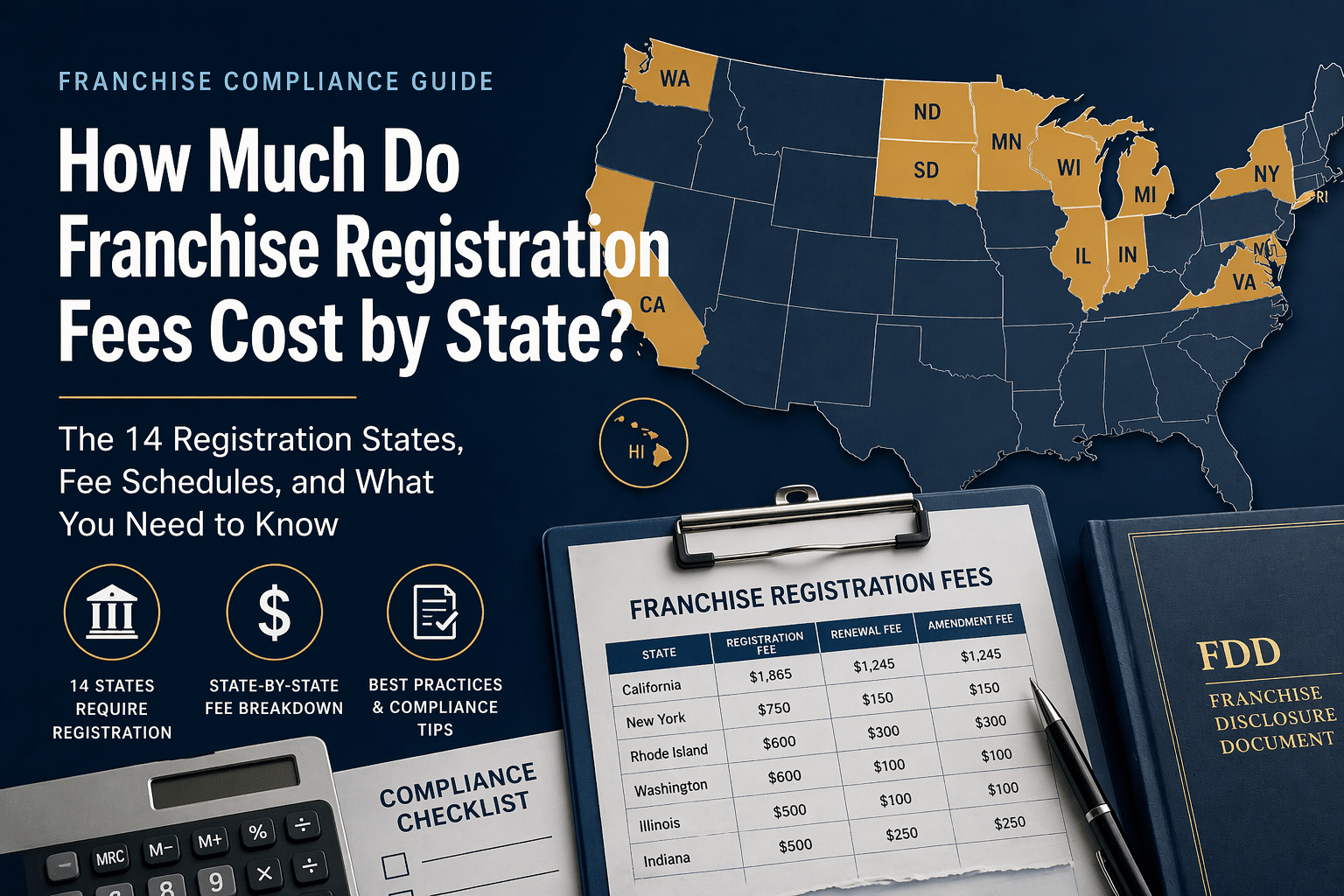
- 14 states require franchise registration before you can legally offer or sell a franchise — and most charge fees to do it.
- California has the highest renewal fee at $1,865. New York, Rhode Island, and Washington are also among the more expensive states.
- Several states do not require franchise registration but do have business opportunity laws with their own separate fees.
- Renewal and amendment timelines vary by state — missing them can suspend your ability to sell.
- Working with a franchise attorney before entering any registration state is not just smart. It is the safest way to avoid rescission claims and enforcement exposure.
What’s inside:
- The 14 franchise registration states and their fee schedules
- A full state-by-state fee table
- What triggers business opportunity laws in non-registration states
- Best practices for each registration state
- Common compliance mistakes that create legal exposure
There is no single answer to how much franchise registration costs. It depends entirely on which states you want to sell in — and those states have very different rules, very different fee schedules, and very different expectations for what a compliant FDD looks like.
Most franchisors find out about registration states the hard way: they launch their franchise program, start marketing nationally, and then get a call from a prospective franchisee in California or New York asking when they plan to register. Sometimes they have already accepted a deposit. That is a problem.
This post breaks down exactly which states charge franchise registration fees, what those fees are, and what you need to know about doing business in each of them the right way.
The 14 Franchise Registration States
The United States is divided, from a franchise regulation standpoint, into two camps: registration states and non-registration states. In registration states, you cannot legally offer or sell a franchise until your FDD has been reviewed and approved (or deemed approved) by the state. Advertising a franchise opportunity before that approval is also typically prohibited.
The 14 registration states are:
- California
- Hawaii
- Illinois
- Indiana
- Maryland
- Michigan
- Minnesota
- New York
- North Dakota
- Rhode Island
- South Dakota
- Virginia
- Washington
- Wisconsin
Wisconsin is sometimes treated as a gray area — it has strong franchise disclosure requirements but its registration process works differently than the others. If you are planning to sell in Wisconsin, you need to understand those distinctions.
Each of these states runs its own review process with its own timeline, its own fee structure, and its own required documents. There is no single registration that covers all 14. You file separately in each state where you intend to offer franchises.
Franchise Registration Fees by State
Below is a full breakdown of registration fees, renewal fees, and amendment fees for each state. These are based on current schedules — fees and requirements are subject to change, so always confirm directly with the state or your franchise attorney before filing.
| State | Registration Required | Renewal Fee | Amendment Fee | Biz Opp Registration | Exempt Renewal |
|---|---|---|---|---|---|
| California | Yes | $1,865 | $1,245 | Yes ($50) | $100 |
| Hawaii | Yes | $250 | $250 | N/A | N/A |
| Illinois | Yes | $500 | $100 (mat. change) | Yes ($300) | $300 |
| Indiana | Yes | $500 | $250 | Yes ($50) | $50 |
| Maryland | Yes | $500 | $250 | Yes ($250) | $250 |
| Michigan | Yes | $250 | $250 | Yes | N/A |
| Minnesota | Yes | $400 | $200 | Yes (FTC Rule) | N/A |
| New York | Yes | $750 | $150 | N/A | N/A |
| North Dakota | Yes | $250 | $100 | N/A | N/A |
| Rhode Island | Yes | $600 | $300 | N/A | N/A |
| South Dakota | Yes | $250 | $150 | Yes ($100) | — |
| Virginia | Yes | $500 | $250 | Yes | N/R |
| Washington | Yes | $600 | $100 | Yes ($200) | $200 |
| Wisconsin | Yes | $400 | Annual Reg. | N/A | N/A |
Note: Amounts and requirements are subject to change without notice. N/A = not applicable. N/R = no renewal required.
What Business Opportunity Laws Mean for Non-Registration States
Even if a state is not on the registration list, that does not mean you can sell there without any compliance obligations. Plenty of states have business opportunity laws that apply to franchise-like arrangements, and several of them charge their own separate fees.
Texas, Florida, Connecticut, Nebraska, and others have business opportunity registration requirements that can apply depending on how your franchise is structured. The threshold for what counts as a regulated “business opportunity” varies by state. Some use earnings claims as the trigger. Others look at required purchases from the franchisor.
Alabama, Georgia, Iowa, Louisiana, Maine, North Carolina, Ohio, Oklahoma, and South Carolina all appear in the fee chart above with business opportunity fees or notice requirements. Just because there is no franchise-specific registration does not mean you are in the clear.
The safest approach: before you market in any state, have a franchise attorney confirm whether that state’s business opportunity law applies to your offering and what, if anything, you need to file.
State-by-State Best Practices
California
California has the most rigorous review process of any registration state. The Department of Financial Protection and Innovation (DFPI) conducts a substantive review — not just a filing check — and they will send comments. Budget 90 to 120 days for initial registration, possibly longer for a first-time registrant.
The $1,865 renewal fee is the highest in the country. California also requires a separate notice to be filed with the state for any material change to the FDD. Do not assume your California registration is current just because you renewed at the federal level. Renewals are annual and due by April 30.
- Get your FDD registered before you generate any California leads. Any marketing activity that could be seen as advertising a franchise opportunity — including lead capture pages — can trigger the advertising rules.
- California requires audited financial statements. If your financials are not audit-ready, start there.
New York
New York’s process is handled by the Attorney General’s office. The $750 renewal fee reflects what is one of the more demanding state review processes. New York has specific requirements around escrow or financial assurance for new franchisors without audited financials showing sufficient net worth.
New York also has specific rules about earnings claims in advertising. Item 19 disclosures need to be carefully drafted if you intend to market in the state.
- Plan for a review period of 60 to 90 days for initial registration.
- Make sure your FDD’s Item 19 is tight before filing. New York examiners pay attention to it.
Maryland
Maryland operates on a 12-month registration cycle tied to your fiscal year, not a calendar year. The $500 renewal fee applies annually. Maryland is generally considered a moderately demanding registration state — not as intensive as California or New York, but not a rubber-stamp process either.
- File your renewal at least 30 days before your registration expires to avoid a lapse.
- Maryland requires disclosure of any litigation or administrative actions. Keep that section of your FDD current.
Washington
Washington’s $600 renewal fee puts it among the higher-cost states. The state has a business opportunity registration requirement in addition to the franchise registration, which is why it appears twice in the fee chart. The amendment fee is $100, which is lower than many states — but Washington does require timely amendment filing when material changes occur.
- Washington has a 120-day renewal window before your registration expires. Do not wait until the last minute.
- Business opportunity registration is separate from franchise registration. Confirm with your attorney which one (or both) applies.
Illinois
Illinois has a two-part fee structure: $500 for the initial registration and a $100 amendment fee for material changes. It also requires an annual report. The business opportunity registration carries a $300 fee.
Illinois is known for moving relatively quickly through the review process compared to California and New York, but their examiners will flag issues with Item 19 disclosures and litigation history.
- File your annual report on time. Missing it puts your registration at risk.
- Illinois is strict about how you present financial performance information to prospects.
Minnesota
Minnesota charges $400 for registration and $200 for amendments. It also requires an annual report. Minnesota has an interesting exemption structure — franchisors meeting certain financial thresholds can qualify for an FTC Rule exemption, which simplifies the process.
- Check whether you qualify for the FTC Rule exemption before going through full registration.
- Minnesota requires your FDD to be delivered 10 business days before signing — slightly different from the FTC’s 14-calendar-day rule.
Rhode Island
At $600 for renewal and $300 for amendments, Rhode Island is one of the more expensive non-California states. The process is administered through the Department of Business Regulation. Review timelines are generally faster than the major markets.
- Rhode Island treats any promotional material for a franchise as a regulated advertisement. Have your compliance documents in order before running any campaigns.
Indiana, Hawaii, North Dakota, South Dakota, Michigan, and Virginia
These states generally have lower fee schedules — ranging from $250 to $500 for registration — and tend to have more streamlined review processes than the larger states. That said, each has its own quirks:
- Indiana requires a $50 exemption renewal fee for qualifying franchisors.
- Hawaii does not have a business opportunity registration requirement.
- North Dakota has no business opportunity law at all.
- South Dakota requires an annual report as part of the amendment filing.
- Michigan sends an annual notice rather than requiring a formal renewal in some cases.
- Virginia does not charge a renewal fee for exempt registrations.
Even in the “easier” registration states, do not assume the process is automatic. States can and do request additional information, issue comments, or require amendments before approving a registration.
Common Compliance Mistakes That Create Real Legal Risk
The fees matter. But the bigger risk is not what registration costs — it is what happens when you do not register, or when your registration lapses.
In registration states, selling a franchise without a current, approved registration exposes you to rescission. That means the franchisee can void the agreement and get their money back. In California, they can do this for up to four years after signing. That is not a theoretical risk. It comes up in litigation.
The most common mistakes franchisors make in registration states:
- Marketing in a state before registration is approved. Lead generation counts. So does a landing page with your phone number.
- Missing a renewal deadline and continuing to sell. There is no grace period in most states.
- Failing to file an amendment when a material change occurs. A change in Item 19, new litigation, or a change in fees all require prompt amendment filings.
- Assuming that out-of-state advertising does not count. If a California resident sees your ad and responds, California may treat that as an offer in California.
- Not tracking individual state expiration dates. Each state has its own calendar. Most franchisors with national programs use a compliance calendar managed by their franchise attorney.
Why You Need a Franchise Attorney Before You File
The fee chart above tells you what you will pay. It does not tell you whether your FDD is ready, whether your financial statements are in the right format, whether your Item 19 will pass review, or whether any of your marketing materials will trigger an advertising violation before you even file.
Registration is not just a paperwork exercise. States review FDDs substantively. California examiners read every exhibit. New York will comment on your personal background disclosures. Minnesota will flag ambiguous financial performance claims.
Franchise Business Law Group works with franchisors through the full registration process — from FDD preparation and drafting to multi-state filing coordination to renewal management. If you are approaching your first registration state, or expanding into new markets, we can help you move efficiently without creating compliance exposure.
The cost of getting it wrong is significantly higher than the cost of doing it right the first time.
Ready to register in your target states?
Franchise Business Law Group has helped franchisors navigate registration in all 14 states. Whether you’re filing for the first time or managing an existing multi-state program, our team can help you stay compliant and move faster. Contact us to schedule a consultation.
Visit: www.franchisebusinesslawgroup.com/franchise-law
Frequently Asked Questions About Franchise Registration Fees
1. What is a franchise registration state?
A franchise registration state requires franchisors to file and receive approval (or deemed approval) from a state regulator before they can legally offer or sell a franchise there. There are 14 of them in the U.S. Each has its own process, fees, and timeline.
2. Which state has the highest franchise registration fee?
California. The renewal fee is currently $1,865, which is significantly higher than any other state. California also has the most demanding review process, often taking 90 to 120 days for initial registration.
3. What happens if I sell a franchise in a registration state without registering?
The franchisee may have the right to rescind the agreement and demand their investment back. California, for example, allows this for up to four years after the sale. Beyond rescission, you can face civil penalties and enforcement actions from the state regulator.
4. Do I have to register in every state where I sell franchises?
You only need to register in states that require it — the 14 registration states. In other states, you may still have compliance obligations under business opportunity laws, but there is no franchise registration process to complete.
5. How often do I need to renew my franchise registration?
Most states require annual renewal. The timing varies — California requires renewal by April 30, while other states tie renewal to your fiscal year or the anniversary of your original registration. Missing a renewal deadline and continuing to sell can expose you to the same risks as never registering at all.
6. What is an amendment fee and when does it apply?
An amendment fee applies when you need to update your FDD due to a material change — new litigation, a change to your fees, an update to Item 19, a change in ownership, or other significant developments. Most states require you to file the amendment before continuing to offer franchises. Fees range from $50 to $300 depending on the state.
7. Can I market my franchise before registration is approved?
Generally, no. In most registration states, advertising a franchise opportunity before your registration is approved — including lead generation and social media ads — is prohibited. Some states have mechanisms for limited advertising prior to approval, but these are narrow exceptions. Talk to your franchise attorney before launching any marketing in a registration state.
8. What is a business opportunity registration, and how is it different from franchise registration?
Business opportunity registration is a separate requirement that exists in many non-registration states. It applies to arrangements where a seller offers a business opportunity — often including a required purchase, an earnings claim, or territorial rights. Some franchise arrangements trigger business opportunity laws in addition to, or instead of, franchise-specific laws. They are different filings with different regulators and different fees.
9. Are franchise registration fees tax deductible?
State registration fees are generally deductible as ordinary business expenses, but the treatment depends on your specific situation. Talk to your accountant or tax advisor about how to categorize them for your business.
10. How does Franchise Business Law Group help with franchise registration?
We handle the full registration process: FDD preparation and review, state-specific filing requirements, coordination with state regulators, amendment filings when material changes occur, and annual renewal management. If you are entering registration states for the first time or managing a multi-state program, we can help you stay compliant without losing sales momentum.